Machine Learning with PyTorch and Scikit-Learn
Product ID: 391326528
Desertcart purchases this item on your behalf and handles shipping, customs, and support to Barbados.
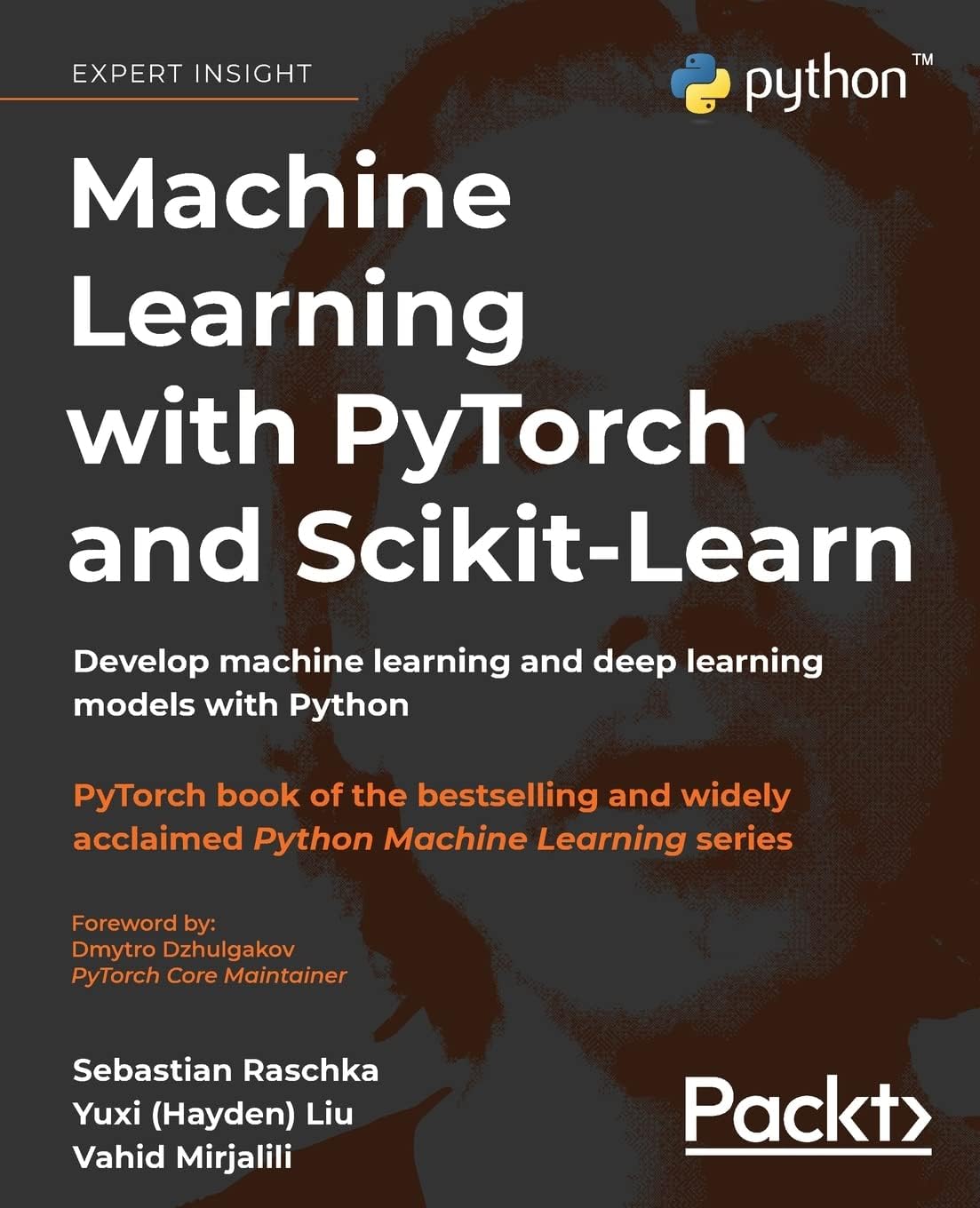
This book of the bestselling and widely acclaimed Python Machine Learning series is a comprehensive guide to machine and deep learning using PyTorch's simple to code framework. Purchase of the print or Kindle book includes a free eBook in PDF format. Key Features Learn applied machine learning with a solid foundation in theory Clear, intuitive explanations take you deep into the theory and practice of Python machine learning Fully updated and expanded to cover PyTorch, transformers, XGBoost, graph neural networks, and best practices Book Description Machine Learning with PyTorch and Scikit-Learn is a comprehensive guide to machine learning and deep learning with PyTorch. It acts as both a step-by-step tutorial and a reference you'll keep coming back to as you build your machine learning systems. Packed with clear explanations, visualizations, and examples, the book covers all the essential machine learning techniques in depth. While some books teach you only to follow instructions, with this machine learning book, we teach the principles allowing you to build models and applications for yourself. Why PyTorch? PyTorch is the Pythonic way to learn machine learning, making it easier to learn and simpler to code with. This book explains the essential parts of PyTorch and how to create models using popular libraries, such as PyTorch Lightning and PyTorch Geometric. You will also learn about generative adversarial networks (GANs) for generating new data and training intelligent agents with reinforcement learning. Finally, this new edition is expanded to cover the latest trends in deep learning, including graph neural networks and large-scale transformers used for natural language processing (NLP). This PyTorch book is your companion to machine learning with Python, whether you're a Python developer new to machine learning or want to deepen your knowledge of the latest developments. What you will learn Explore frameworks, models, and techniques for machines to 'learn' from data Use scikit-learn for machine learning and PyTorch for deep learning Train machine learning classifiers on images, text, and more Build and train neural networks, transformers, and boosting algorithms Discover best practices for evaluating and tuning models Predict continuous target outcomes using regression analysis Dig deeper into textual and social media data using sentiment analysis Who this book is for If you have a good grasp of Python basics and want to start learning about machine learning and deep learning, then this is the book for you. This is an essential resource written for developers and data scientists who want to create practical machine learning and deep learning applications using scikit-learn and PyTorch. Before you get started with this book, you’ll need a good understanding of calculus, as well as linear algebra. Table of Contents Giving Computers the Ability to Learn from Data Training Simple Machine Learning Algorithms for Classification A Tour of Machine Learning Classifiers Using Scikit-Learn Building Good Training Datasets – Data Preprocessing Compressing Data via Dimensionality Reduction Learning Best Practices for Model Evaluation and Hyperparameter Tuning Combining Different Models for Ensemble Learning Applying Machine Learning to Sentiment Analysis Predicting Continuous Target Variables with Regression Analysis Working with Unlabeled Data – Clustering Analysis Implementing a Multilayer Artificial Neural Network from Scratch (N.B. Please use the Look Inside option to see further chapters) Review: Well-Structured and Practical - This is an excellent hands-on book for learning modern machine learning with Python. I especially like how it combines both scikit-learn and PyTorch, covering everything from ML fundamentals to deep learning in a clear, structured way. The explanations are easy to follow, the code examples are practical, and the content is well organized. Whether you're a student, practitioner, or looking to refresh your knowledge, this book is a great resource to keep on your shelf. Highly recommended! Review: Excellent book on ML - This is a great book on machine learning. Topics covered are extensive - from beginner level to advanced topics including math behind different algorithms. However, not "all" algorithms are covered. Please go through the table of contents. The first part - 11 chapters - covers machine learning concepts and second part covers advanced topics with Pytorch. There are lots of excellent code and they work!! The quality of the book I received is excellent. I have gone through all 742 pages, and it has held up very well!! I used Jupyter notebook to run all examples. I created a new notebook and copied and pasted the code and ran them. This approach worked very well for me. At the same time, I could experiment with my take on the code snippets and definitely added to my knowledge. Only issue I have is on the second part of the book discussing PyTorch: (1) Some packages are a bit older version: e.g., transformer 4.9.1 whereas current version is 4.48+. It took some tweaking/recoding to get the examples working. (2) There is not much discussion on why certain architecture was chosen - e.g., number of layers, is there a rule of thumb on how to improve performance by changing these parameters? Even with CUDA the code run for a long time. Therefore, experimenting with different values of parameters become too time consuming. (3) On the same note, if I can achieve test accuracy of 90%+ using logistic regression and almost the same (perhaps one or two percent better with PyTorch with IMDB movie review dataset and that two much faster why should I use PyTorch for this dataset? Obviously, PyTorch is for certain types of problems. Discussions can be included by not adding to the exhaustive (and apt) contents. Personally I was disappointed by lack of any example on time series. Must have for ML practitioner as a reference and guide.



| Best Sellers Rank | #48,090 in Books ( See Top 100 in Books ) #1 in Speech & Audio Processing #14 in Computer Neural Networks #15 in Python Programming |
| Customer Reviews | 4.6 out of 5 stars 528 Reviews |
A**R
Well-Structured and Practical
This is an excellent hands-on book for learning modern machine learning with Python. I especially like how it combines both scikit-learn and PyTorch, covering everything from ML fundamentals to deep learning in a clear, structured way. The explanations are easy to follow, the code examples are practical, and the content is well organized. Whether you're a student, practitioner, or looking to refresh your knowledge, this book is a great resource to keep on your shelf. Highly recommended!
P**R
Excellent book on ML
This is a great book on machine learning. Topics covered are extensive - from beginner level to advanced topics including math behind different algorithms. However, not "all" algorithms are covered. Please go through the table of contents. The first part - 11 chapters - covers machine learning concepts and second part covers advanced topics with Pytorch. There are lots of excellent code and they work!! The quality of the book I received is excellent. I have gone through all 742 pages, and it has held up very well!! I used Jupyter notebook to run all examples. I created a new notebook and copied and pasted the code and ran them. This approach worked very well for me. At the same time, I could experiment with my take on the code snippets and definitely added to my knowledge. Only issue I have is on the second part of the book discussing PyTorch: (1) Some packages are a bit older version: e.g., transformer 4.9.1 whereas current version is 4.48+. It took some tweaking/recoding to get the examples working. (2) There is not much discussion on why certain architecture was chosen - e.g., number of layers, is there a rule of thumb on how to improve performance by changing these parameters? Even with CUDA the code run for a long time. Therefore, experimenting with different values of parameters become too time consuming. (3) On the same note, if I can achieve test accuracy of 90%+ using logistic regression and almost the same (perhaps one or two percent better with PyTorch with IMDB movie review dataset and that two much faster why should I use PyTorch for this dataset? Obviously, PyTorch is for certain types of problems. Discussions can be included by not adding to the exhaustive (and apt) contents. Personally I was disappointed by lack of any example on time series. Must have for ML practitioner as a reference and guide.
A**R
Just learning it
Nice learning book just have to finish it
R**N
Excellent Textbook for Hands-On Learning of ML
This textbook is for the serious life-long learners of machine learning. There are at least two ways to ‘consume’ this book. For the expert in ML, this is a textbook to study as a clear comprehensive ML overview and then to dive into sections of interest or ignorance. The concepts are grounded in code examples and are well cited (with links) to sources. Further, this textbook is appropriate if you are TensorFlow-centric and want to broaden into cutting-edge ML models/tools coded in PyTorch. For a new learner to ML, this is a textbook to DO (not just READ) with hands-on and brain-engaged. If you realize that ML is a key life-long skill for your career, consider this textbook as part of a daily learning habit (10-30 min). From personal experience, my advice to the new learner is as follows… First, clone the GitHub repository, setup your Python environment, and study the textbook, while working through the notebooks. Go on tangents and break the code. Do this methodically as part of your daily learning habit, but do not hesitate to jump ahead several chapters to prepare for tomorrow’s meeting. There is enough excellent material here for a full year of ML adventures. I did a similar strategy with Raschka’s first textbook. About four years ago, I had finished Andrew Ng’s Deep Learning Specialization as a student in his first cohort. I knew the concepts well but could not do the actual application coding. I was surprised how my Python coding improved by following Raschka’s clean and elegant style. And Raschka’s code examples were meaty enough to be springboards into working applications. Several textbook editions later, what is different about this new edition? First, it moves you through scikit-Learn (a firm foundation) to PyTorch, instead of TensorFlow. PyTorch is a better stepping-stone, both conceptually and practically. With PyTorch, you will go further with less energy, while being able to convert your efforts into TensorFlow as needed. In addition, most of the cutting-edge ML/AI/DL research is in PyTorch. It is nice to read a recent arXiv paper, clone their repository, click on the Colab tutorial, and replicate their experiments, along with picking up a ton of new coding tricks & tips. I am excited to work through these PyTorch sections to hone my skills. Second, there is a clear recognition of model tracking and tuning practices. This is often a gap in other ML textbooks and courses. Once you progress beyond the simple demo examples in a lecture, you realize that the real work is experiments, more experiments, and still more experiments, so that you must understand what the model architecture and hyperparameters are doing to your dataset. There is good coverage of scikit-Learn pipeline, grid search, model performance, and the like. Third, ML/AI/DL practice is rapidly evolving. Every week new ML packages/services become available that could save much grief on your current project. What is refreshing about Raschka’s textbook series is that he constantly adding cutting-edge topics because he likes to stay current and to help us stay current. Hence, this edition contains recent ML treats as: transformers, self-supervised learning, autoencoders-to-GAN, graph neural networks, DBSCAN, t-SNE (with brief mention of UMAP), and PyTorch-Lightning.
M**A
One of the best machine learning books...
Machine Learning can often be intimidating whether you are starting out or already a practitioner. It is easy to get stuck on one concept, walk away frustrated, or just copy that code you find on StackOverflow without really understanding what it does. What the authors of this book, Machine Learning with PyTorch and Scikit-Learn, have managed to do is to keep the reader engaged giving a deeper illustration as to how the concepts work. In this book, you get practical code examples, a detailed explanation of how the various library tools work, and exposure to the mathematical concepts behind machine learning algorithms. In addition, what I like about the book unlike many machine learning books is that the authors have managed to intuitively explain how each algorithm works, how to use them, and the mistake you need to avoid. I have not read a Machine Learning book that better explains Transformers as this one does. The authors have managed to give a detailed dive into this model architecture through well-explained codes and illustrations. As a reader, you walk away having intuitively grasped the concepts of attention and self-attention in ways that will make this crucial NLP architecture clear. You get exposed to pre-trained models from HuggingFace library which really helps to have that hands-on experience working with large datasets. As they have done throughout the book, the authors have broken down those complex mathematical operations into simple explanations that are easy to follow. What I generally like about the book is how it seamlessly connects all the chapters, not throwing off the reader. There are numerous external resources quoted throughout the book. This helps spark that curiosity to dig deeper. In addition, you get introduced to PyTorch, getting exposed to all those sophisticated libraries that help the reader learn how to maximize their compute power. I would say it is not intimidating at all even if you have not used PyTorch before. I would recommend this book to anybody seeking a textbook that is both easy to read and modern in its content. If were to rate the book I will give it a 10/10 as it really applies to both beginners and experienced practitioners, covers all the concepts one needs to apply in their operations, and acts as a quick reference.
G**L
Thorough Primer for Machine Learning and PyTorch
BLUF: A thorough primer for machine learning enthusiasts with plenty of theory to underscore its many practical examples. A definite must-have for anyone looking to add PyTorch to their machine learning tool belt. PROS: - Extremely thorough (if not comprehensive). I really appreciate that this book doesn't just thrust one into building models with PyTorch. It starts at the "beginning" and provides examples, theory, additional resources, and citations along the way. - Theory. Those whose calculus and linear algebra courses ended many years ago will appreciate (if not remember exactly) the mathematical theory and notation that accompanies almost every paragraph. This book gives one the opportunity to "dig deeper" or stay in the shallows until the notation stops. - Python. Rather than simply utilizing Scikit-Learn to illustrate concepts and introduce models, this book contains many sections where models (such as a Perceptron) are coded from the ground up so the reader can fully understand the underlying mechanics. Python enthusiasts will nerd out. Parents of small children might want to skip a few pages. - Graphs, charts, and graphics. There are plenty of places where a drier text might have foregone the use of graphs. This text does not. It does however refrain from overusing them. - PyTorch. This should be obvious from the title, but this text prioritizes PyTorch instead of TensorFlow. This is especially helpful for those looking for an alternative to Keras and TensorFlow as the PyTorch API is very user-friendly. CONS: - Almost too much code. This isn't a true "con" but anyone wanting to emulate or follow along with the examples would do well to get the digital edition so they can copy and paste. - Length and complexity. Anyone hoping for a "quick read" or a "quick start guide" will be disappointed. This book hovers somewhere between an undergraduate primer and a graduate-level text for length and readability. This is not to say that it's difficult to read, merely that there are other "quick start" / "practical" texts out there that cater more to a lay audience.
K**R
Comprehensive Guide to Learning Machine Learning Through PyTorch
I found a very interesting book and picked it up as quickly as I could. It's a complete guide to machine learning that focuses on PyTorch rather than TensorFlow. I greatly appreciate that this book exists as it gives developers a choice of which library to learn about. This is a great book for anyone wanting to get into machine learning as well as someone changing careers. I highly encourage both to check out this book. While the book isn't split up into sections, the divisions are clear. The first ten chapters discuss the fundamentals of machine learning, everything from basic definitions to cleaning data to a few projects. I always encourage people to do the projects and share them as a portfolio; this book makes it easier to do so. Chapter 11 looks at a general neural network before moving on to using PyTorch in chapters 12 and 13. The remaining chapters use PyTorch to build projects that give the reader a wide variety of experience. For the first time in any technical book that I've yet seen, the final section of the final chapter includes a book summary to help reinforce what the reader has learned. I appreciate this and hope more authors include this in the future. This really is a good book. I will be recommending this to anyone who wants a hands-on approach to learning machine learning.
M**S
Ignorance is gone! I am becoming smarter.
I haven't completed reading this book yet, but so far, this book is rapidly clearing my ignorance. Once I am done reading, I will surely edit this. This book is anyone’s dream if the goal is to master Machine Learning and PyTorch in one go.
A**R
This book could make PyTorch mainstream
I have used Sebastian Raschka's books in my teaching at the University Of Oxford before As usual, this book is excellent in its technical detail and thoroughness. However, it could also help to make PyTorch more mainstream. PyTorch has been gaining traction, but still mostly in the academic / research community. PyTorch has some excellent libraries (such as fast.ai) but still the world of PyTorch is a bit away from traditional Python for ML But by taking an approach of Scikit-Learn and PyTorch, this book could introduce PyTorch to a larger/mainstream audience of SKLearn users using a familiar paradigm. On first impressions, technically, the book is very much an enhancement of the previous book from Sebastian also (ex now includes transformers and GANs). Finally, I am also interested in PyTorch from the perspective of the metaverse. So, all in all an excellent - must read book - another great reference book from the author
L**I
Gooood
Veryyyyyyyyy goood
I**K
a word perfect
everyone need this book i loved
D**S
Good as described
The book is as described.
D**.
Excelente libro para ingresar en la industria.
Es un excelente libro que nos permite aprender sobre ML y aplicarlo sin dejar de lado la teoría! Si lo lees completo, es como tomar un curso de ML bastante bueno, y estás listo para un rol de junior o más en el campo. Obvio, sin dejar de lado las bases matemáticas (que también las explica).
Trustpilot
1 month ago
2 months ago